
The Australian education landscape has undergone a seismic shift. From the notebook-lined desks of the early 2000s to the 1-to-1 iPad programs in Sydney’s high schools and the fully remote lecture halls of Melbourne’s universities, technology is no longer a tool—it is the environment.
For students in High School and Higher Education, this digital integration is a double-edged sword. While it offers unprecedented access to information and global connectivity, it has also introduced a complex suite of mental health challenges. As we navigate 2026 and beyond, understanding the intersection of screen time, academic pressure, and psychological well-being is critical for students, educators, and parents alike.
The Australian Context: A Hyper-Connected Youth
Australia remains one of the most digitally active nations in the world. Recent 2026 data indicates that nearly 99% of Australian teenagers are online daily. While this connectivity allows a student in rural Queensland to access the same resources as one in metropolitan Perth, it also means Australian students are uniquely vulnerable to the “always-on” culture.
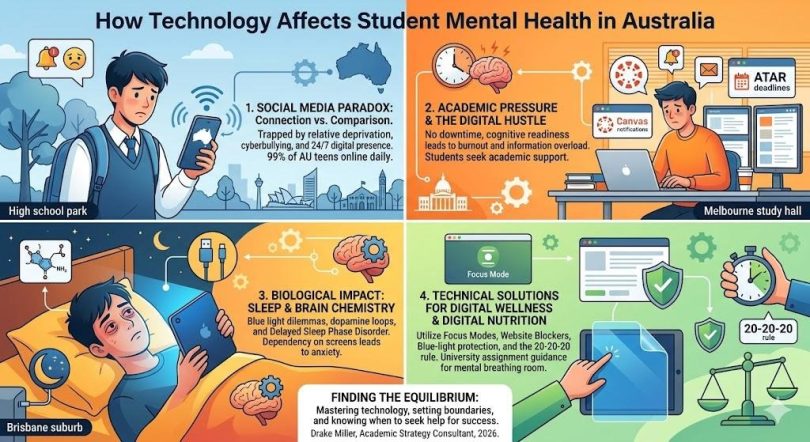
1. The Social Media Paradox: Connection vs. Comparison
For the modern Australian student, social life doesn’t end when the school bell rings; it simply migrates to TikTok, Instagram, and the latest augmented reality social platforms. This constant connectivity can sometimes blur the lines between leisure and academic responsibilities. For instance, many students struggling to balance their digital social lives with university requirements in Queensland often turn to online assignment help Brisbane to maintain their grades while managing their screen time.
- The Comparison Trap: Today, students compare their “behind-the-scenes” lives to the “highlight reels” of peers and influencers globally. This often leads to “Relative Deprivation”—the feeling that one is lacking compared to others, a significant trigger for anxiety.
- Cyberbullying and Regulation: The Australian eSafety Commissioner has reported a steady rise in digital harassment. With the 2026 discussions regarding social media age limits, the focus has shifted toward protecting younger students from the “pocket-sized” harassment that follows them home.
2. Academic Pressure and the Digital “Hustle”
Technology has streamlined learning, but it has also increased the pace of expectations. With platforms like Canvas and Blackboard, students are reachable 24/7.
- The Death of Downtime: Notifications about upcoming ATAR requirements or university assignment deadlines often pop up during dinner. This constant state of “cognitive readiness” prevents the brain from resting, leading to burnout.
- Information Overload: The sheer volume of data can be paralyzing. When a Year 12 student researches a complex topic—be it advanced calculus or specialized accounting assignment help — they face thousands of conflicting sources. To manage this, many students seek professional academic support to help structure their research and maintain high standards without sacrificing their mental health.
3. The Biological Impact: Sleep and Brain Chemistry
- The Blue Light Dilemma: Blue light emitted from screens suppresses melatonin. Australian studies show high school students using devices before bed risk “Delayed Sleep Phase Disorder,” correlating with irritability and poor concentration.
- Dopamine Loops: Apps are designed using “persuasive technology.” For a developing brain (which doesn’t fully mature until 25), this can lead to a dependency where students feel anxious when not engaged with a screen.
4. Technical Solutions for Digital Wellness
Since we are using technology to learn, we must use it to protect our focus. Students should consider:
- Focus Modes: Utilizing “Work” or “Study” profiles on macOS and Windows to silence non-academic notifications.
- Website Blockers: Tools like Cold Turkey or Freedom can help “quarantine” distracting sites during peak study hours.
- Hardware Adjustments: Investing in blue-light filtering screen protectors or high-refresh-rate monitors to reduce eye strain during long research sessions.
5. Strategies for “Digital Nutrition”
- The 20-20-20 Rule: Every 20 minutes, look at something 20 feet away for 20 seconds.
- Physical Boundaries: Establish “No-Tech Zones” like the dining table.
- Scheduled Support: Recognize when the workload is impacting health. Utilizing university assignment guidance can help manage semester peaks, providing much-needed mental breathing room.
Frequently Asked Questions
Q.1 How much screen time is too much for a Year 12 student?
While there is no “magic number,” the quality of screen time matters more than the quantity. Active learning is healthier than passive scrolling. However, if digital use interferes with 8 hours of sleep or physical activity, it is likely excessive.
Q.2 What are the signs of digital burnout in university?
Common signs include “brain fog,” irritability when offline, declining grades despite long hours at the computer, and a lack of interest in physical socialising.
Q.3 Can digital tools actually improve mental health?
Yes. In a vast country like Australia, telehealth platforms and apps like Headspace or ReachOut bridge the gap for students in regional areas who need immediate support.
Conclusion: Finding the Equilibrium
The relationship between technology and student mental health in Australia is complex. For high school and university students, the goal is not to escape technology but to master it. By setting boundaries, prioritizing sleep, and knowing when to seek help—whether through mental health services or academic assistance—students can ensure their digital tools remain servants to their success.
About the Author
Drake Miller is a senior content manager and academic strategy consultant with over 12 years of experience in higher education and digital strategy. Based in Australia, Drake specializes in the integration of Agentic AI and digital literacy within student workflows. He is a frequent contributor to educational forums, focusing on helping students navigate the technological transformations of the 2026 academic landscape.